: Diffusion Models Post-Training for Continuous Reward Control
TL;DR
We introduce , a multi-objective RL framework that trains a single diffusion model to approximate the entire Pareto front, enabling users to continuously navigate competing reward trade-offs at inference time — such as photorealism vs. style, or prompt adherence vs. source preservation — without retraining or maintaining multiple checkpoints.

Abstract
Reinforcement Learning (RL) post-training has become the standard for aligning generative models with human preferences, yet most methods rely on a single scalar reward. When multiple criteria matter, the prevailing practice of "early scalarization" collapses rewards into a fixed weighted sum. This commits the model to a single trade-off point at training time, providing no inference-time control over inherently conflicting goals — such as prompt adherence versus source fidelity in image editing. We introduce , a multi-objective RL (MORL) framework that trains a single diffusion model to approximate the entire Pareto front. By conditioning the model on continuously varying preference weights during RL alignment, we enable users to navigate optimal trade-offs at inference time without retraining or maintaining multiple checkpoints. We evaluate across three state-of-the-art flow-matching backbones: SD3.5, FluxKontext, and LTX-2. Our single preference-conditioned model matches or exceeds the performance of separately tuned baselines while uniquely providing fine-grained, real-time control over competing generative goals.
Method
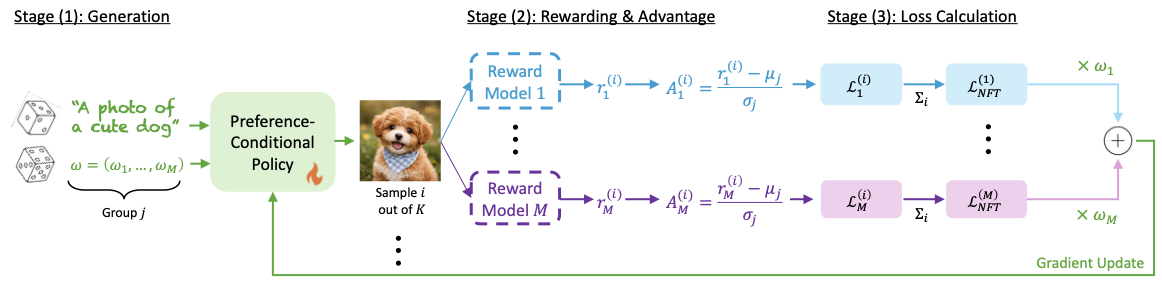
🎯 For each prompt and sampled \(\omega\), the policy generates \(K\) images, conditioning the denoising process on both the input and the user-specified preference vector.
⚖️ Each image is scored by \(M\) reward models and normalized into per-reward advantages, decoupling reward scales so the optimization faithfully respects \(\omega\).
🔧 A DiffusionNFT loss is computed per reward and aggregated with \(\omega\) before the gradient update, steering the model toward the desired Pareto-optimal trade-off.
Text-to-Image: Style Control
Drag the slider to continuously navigate between photorealism and different artistic styles.



Text-to-Video: Style Control
Drag the slider to navigate from photorealism to animation style.
Image Editing: Preservation vs. Adherence
Drag the slider to navigate from full source preservation to full prompt adherence.








Comparisons
| ParetoSlider |  |
 |
 |
 |
 |
| FixedWeight |  |
 |
 |
 |
 |
| Realistic ← \(\omega = (\omega_{\mathrm{real}},\, \omega_{\mathrm{sketch}})\) → Sketch | |||||
| FlowMulti | 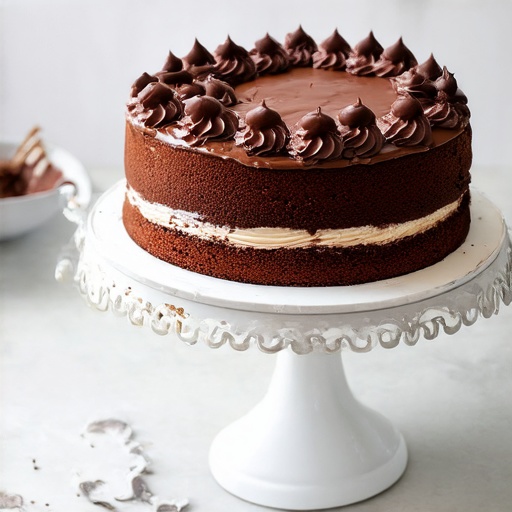 |
 |
 |
Prompting | 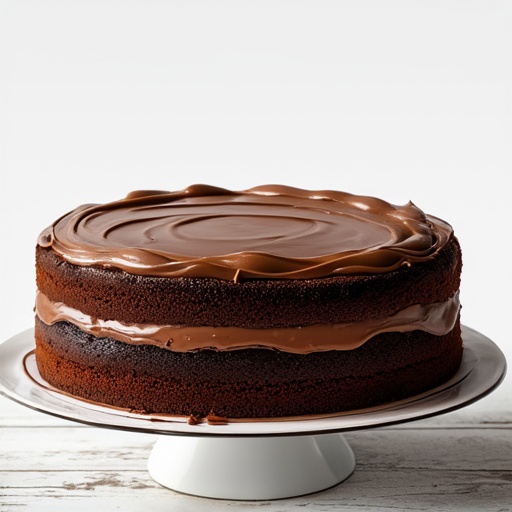 |
 |
 |
| Ep. 100 | Ep. 200 | Ep. 300 | Realistic | Mix | Sketch |
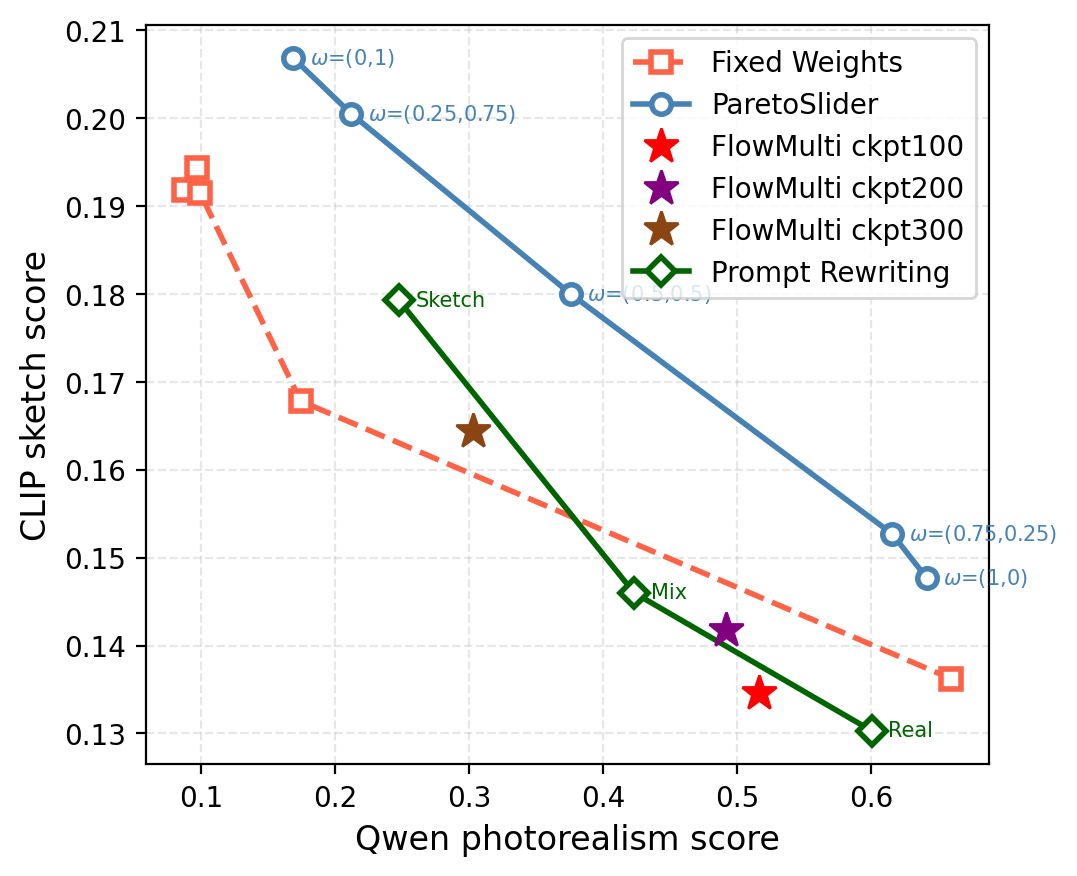
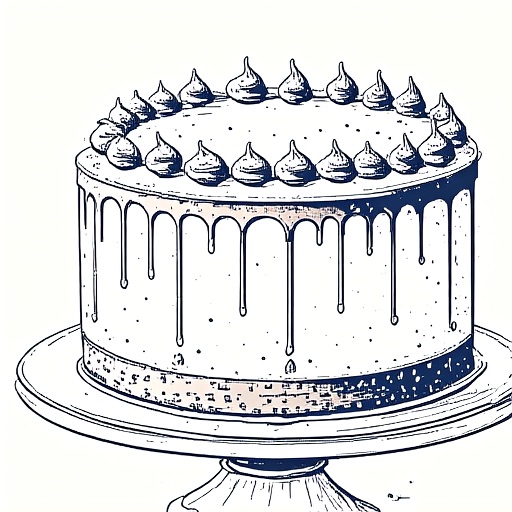
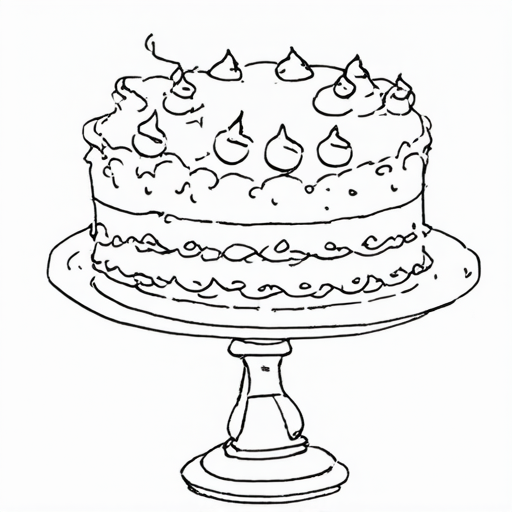
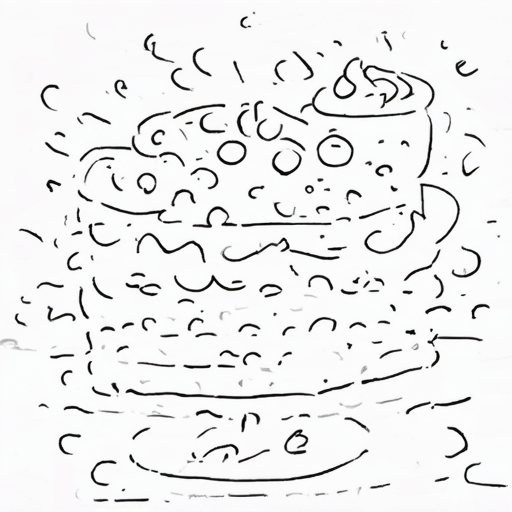
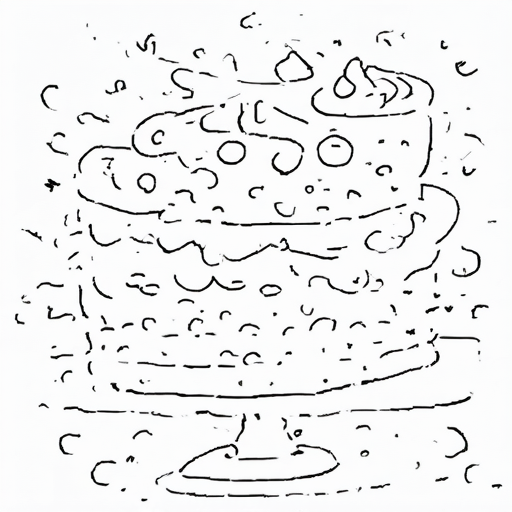
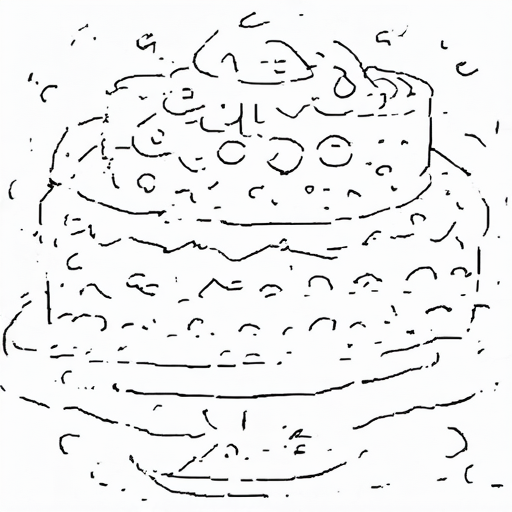
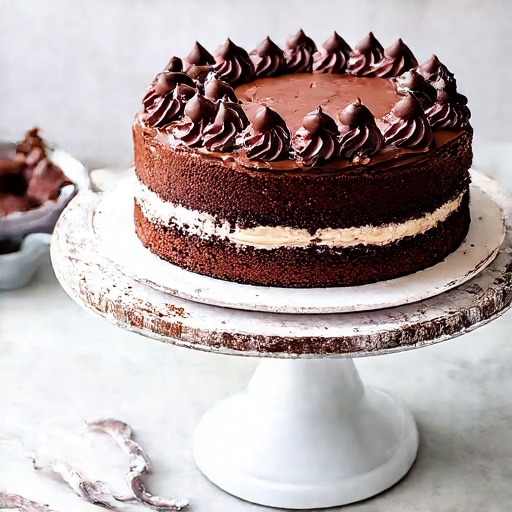
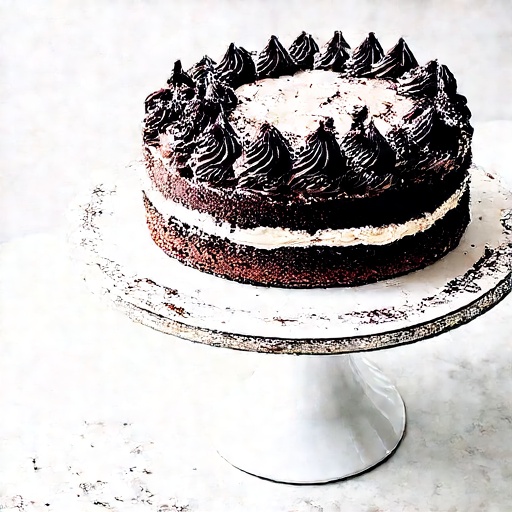
Pareto front and qualitative T2I comparison (SD3.5, Photorealism vs. Sketch) on the prompt "A chocolate cake with frosting on a stand." traces a continuous trade-off curve by varying \(\omega\), dominating Fixed Weights, FlowMulti, and Prompt Rewriting baselines. FixedWeight requires a separate training run per point; FlowMulti produces a single static output; Prompting yields only three coarse points. None support continuous inference-time control.